Cambodia ;
Khmer:
កម្ពុជា,
Kampuchea,
IPA: [kɑmˈpuˈciə]), officially known as the
Kingdom of Cambodia(
Khmer:
ព្រះរាជាណាចក្រកម្ពុជា, Preăh Réachéanachâk Kâmpŭchéa) and once known as the
Khmer Empire, is a country located in the southern portion of the
Indochina Peninsula in
Southeast Asia. Its total landmass is 181,035 square kilometres (69,898 sq mi), bordered by
Thailand to the northwest,
Laos to the northeast,
Vietnam to the east, and the
Gulf of Thailand to the southwest.

With a population of over 15 million, Cambodia is the
69th most populous country in the world. The official religion is
TheravadaBuddhism, practiced by approximately 95 percent of the population. The country's minority groups include
Vietnamese,
Chinese,
Chams, and 30
hill tribes.
[8] The capital and largest city is
Phnom Penh, the political, economic, and cultural center of Cambodia. The kingdom is a
constitutional monarchy with
Norodom Sihamoni, a
monarch chosen by the
Royal Throne Council, as head of state. The head of government is
Hun Sen, who is currently the
longest serving non-royal leader in South East Asia and has ruled Cambodia for over 25 years.
Cambodia's ancient name is "Kambuja" (
Sanskrit: कंबुज). In 802 AD,
Jayavarman II declared himself "King" and marked the beginning of the
Khmer Empire which flourished for over 600 years, allowing successive kings to dominate much of Southeast Asia and accumulate immense power and wealth. The
Indianized kingdom built monumental temples including
Angkor Wat, now a
World Heritage Site, and facilitated the spread of first
Hinduism, then Buddhism to much of Southeast Asia. After the fall of
Angkorto
Ayutthaya in the 15th century, Cambodia was then ruled as a vassal between its neighbors.

The country faces numerous challenges and sociopolitical issues, including widespread poverty, pervasive corruption, lack of political freedoms, low human development, and a high rate of hunger. Cambodia has been described by Human Rights Watch's Southeast Asian Director, David Roberts, as a "vaguely communist free-market state with a relatively authoritarian coalition ruling over a superficial democracy."
While per capita income remains low compared to most neighboring countries, Cambodia has one of the fastest growing economies in Asia with growth averaging 6 percent over the last decade. Agriculture remains the dominant economic sector, with strong growth in textiles, construction, garments, and tourism leading to increased foreign investment and international trade.
Cambodia scored dismally in an annual index (2015) ranking the rule of law in 102 countries, placing 99th overall and the worst in the region. 'The World Justice Project’s Rule of Law Index, which is based on surveys with ordinary people and in-country experts, ranks countries based on eight key indicators including constraints on government powers, an absence of corruption, and regulatory enforcement.' 'In every factor measured, Cambodia scored the worst in the
East Asia and Pacific region, where other ranked nations include Myanmar, Vietnam and Mongolia.' The report notes that “Where the rule of law is weak, medicines fail to reach health facilities, criminal violence goes unchecked, laws are applied unequally across societies, and foreign investments are held back,”
Pre-history
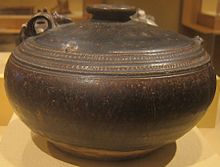
Glazed stoneware dating back to the 12th century.
Some slight archaeological evidence shows communities of
hunter-gatherers inhabited Cambodia during
Holocene: the most ancient Cambodian archeological site is considered to be the cave of
L'aang Spean, in
Battambang Province, which belongs to the
Hoabinhianperiod. Excavations in its lower layers produced a series of
radiocarbon dates as of 6000 BC.
Upper layers in the same site gave evidence of transition to
Neolithic, containing the earliest dated earthenware ceramics in Cambodia
Archaeological records for the period between Holocene and
Iron Age remain equally limited. Other prehistoric sites of somewhat uncertain date are
Samrong Sen (not far from the ancient capital of
Udong), where the first investigations began in 1875, and
Phum Snay, in the northern province of
Banteay Meanchey. An excavation at Phum Snay revealed 21 graves with iron weapons and cranial trauma which could point to conflicts in the past, possible with larger cities in Angkor. Prehistoric artifacts are often found during mining activities in
Ratanakiri.
[20]
However, the most curious prehistoric evidence in Cambodia are the various "circular
earthworks" discovered in the
red soils near
Memotand in the adjacent region of Vietnam in the latter 1950s. Their function and age are still debated, but some of them possibly date from 2nd millennium BC at least.
A pivotal event in Cambodian prehistory was the slow penetration of the first rice farmers from the north, which began in the late 3rd millennium BC.
Iron was worked by about 500 BC, with supporting evidence coming from the
Khorat Plateau, in modern-day Thailand. In Cambodia, some Iron Age settlements were found beneath
Baksei Chamkrong and other Angkorian temples while circular earthworks, were found beneath
Lovea a few kilometers north-west of Angkor. Burials, much richer than other types of finds, testify to improvement of food availability and trade (even on long distances: in the 4th century BC trade relations with India were already opened) and the existence of a social structure and labor organization. At Phum Snay, burial goods included weaponry and skeletons showed evidence on trauma inflicted by violence, indicating warfare between different groups in the area as a result of its strategic location for trade.
Also, among the artifacts from the Iron Age, glass beads are important evidence. Different kinds of glass beads recovered from several sites across Cambodia, such as the Phum Snay site in northwest and the Prohear site in southeast, show that there were two main trading networks at the time. The two networks were separated by time and space, which indicate that there was a shift from one network to the other at about 2nd-4th century AD, probably with changes in socio-political powers.
Pre-Angkorian era and Angkorian era
During the 3rd, 4th, and 5th centuries, the
Indianized states of
Funan and its successor,
Chenla, coalesced in present-day Cambodia and southwestern Vietnam. For more than 2,000 years, what was to become Cambodia absorbed influences from
India, passing them on to other Southeast Asian civilizations that are now Thailand and Laos. Little else is known for certain of these polities, however Chinese chronicles and tribute records do make mention of them. It is believed that the territory of Funan may have held the port known to Alexandrian geographer
Claudius Ptolemy as "
Kattigara". The Chinese chronicles suggest that after Jayavarman I of Chenla died around 690, turmoil ensued which resulted in division of the kingdom into Land Chenla and Water Chenla which was loosely ruled by weak princes under the dominion of
Java.
The
Khmer Empire grew out of these remnants of Chenla becoming firmly established in 802 when
Jayavarman II (reigned c790-850) declared independence from
Java and proclaimed himself a
Devaraja. He and his followers instituted the cult of the
God-king and began a series of conquests that formed an empire which flourished in the area from the 9th to the 15th centuries.
[32] During the rule of
Jayavarman VIII the Angkor empire was attacked by the
Mongol army of
Kublai Khan, however the king was able to buy peace. Around the 13th century, monks from
Sri Lanka introduced
Theravada Buddhism to Southeast Asia. The religion spread and eventually displaced Hinduism and Mahayana Buddhism as the popular religion of Angkor; however it was not the official state religion until 1295; when
Indravarman III took power.
The Khmer Empire was Southeast Asia's largest empire during the 12th century. The empire's center of power was
Angkor, where a series of capitals were constructed during the empire's zenith. In 2007 an international team of researchers using satellite photographs and other modern techniques concluded that Angkor had been the largest pre-industrial city in the world with an urban sprawl of 1,150 square miles.The city, which could have supported a population of up to one million people and
Angkor Wat, the best known and best-preserved religious temple at the site, still serve as reminders of Cambodia's past as a major regional power. The empire, though in decline, remained a significant force in the region until its fall in the 15th century.


